
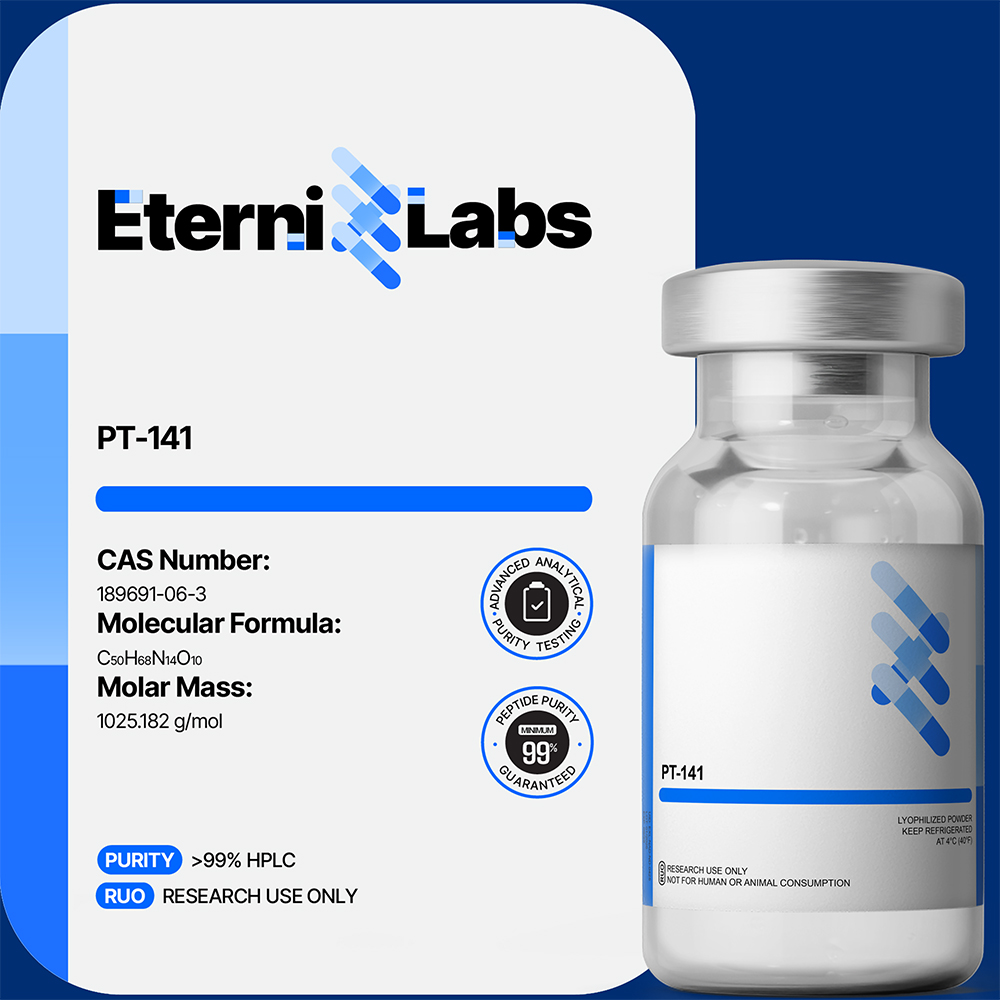
PT-141 (Bremelanotide) is a synthetic heptapeptide analog of α-melanocyte-stimulating hormone (α-MSH), developed for the investigation of melanocortin receptor modulation. Structurally derived from the parent peptide Melanotan II, PT-141 exhibits selective agonist activity at melanocortin-3 and melanocortin-4 receptors (MC3R and MC4R), making it a valuable tool in neuroendocrine research.
In research contexts, PT-141 is primarily used to explore how melanocortin receptors influence behaviors and autonomic responses. Unlike other α-MSH analogs, PT-141 does not bind with high affinity to melanocortin-1 receptors (MC1R), the primary receptors responsible for pigmentation, which makes it especially useful for studies seeking to avoid off-target melanin-related pathways.
Investigations have demonstrated that PT-141 exerts its effects through central nervous system (CNS) modulation, primarily involving hypothalamic and limbic system pathways. These studies have evaluated PT-141 in animal models to understand its impact on appetite control, hormonal signaling, and behavioral conditioning. This peptide has also been explored for its interactions with dopamine and oxytocin pathways, contributing to research on neurochemical signaling.
Researchers have also examined PT-141 in models of stress, reward, and metabolic regulation, further supporting its use in behavioral and physiological studies. Its role in these systems is particularly relevant when studying hormonal interactions, stress-induced behavior, and autonomic function in preclinical trials.
References:
Research into PT-141 has provided valuable insights into the melanocortin system and its impact on central nervous system signaling. This peptide has gained prominence for its selective binding to MC3R and MC4R receptors—targets known to be involved in a range of physiological and behavioral functions in experimental animal models.
Initial studies identified the melanocortin system as a modulator of autonomic and behavioral responses. PT-141, by focusing its effects on the central nervous system, became a tool for investigating these mechanisms without the pigmentation effects seen in MC1R agonists. Its effects are particularly studied in hypothalamic neurons and limbic regions associated with motivation and reward.
In laboratory settings, PT-141 has been employed to examine stress-response pathways, hormonal feedback loops, and social or reward-based behavior in rodents. These applications have helped map the broader role of melanocortin signaling in neuroendocrine activity. Animal models have shown that PT-141 administration can influence dopaminergic signaling and oxytocin modulation, indicating potential intersections between melanocortin and monoamine systems.
Furthermore, PT-141 has been researched for its effects on energy balance. Studies suggest that it may influence hypothalamic pathways related to feeding behavior, similar to other melanocortin receptor agonists. Its role in metabolic and autonomic regulation has drawn attention from researchers studying obesity and metabolic syndrome in non-human models.
Behavioral scientists have utilized PT-141 in models that simulate psychological stimuli and behavioral conditioning. In such settings, the peptide is used to explore how internal peptide signaling can alter response behaviors under various stimuli. These investigations offer potential to better understand how internal neuropeptides affect behavioral and emotional outcomes.
PT-141 also appears in studies evaluating pharmacokinetics and receptor signaling. The peptide’s moderate half-life and blood-brain barrier penetration in some models make it suitable for dose-response and signal transduction studies. Researchers have employed it in various assay formats, including receptor-binding studies, neuroendocrine pathway mapping, and stress-hormone release experiments.
References:
- Diamond, L., Earle, D., Rosen, R., Willett, M., & Molinoff, P. (2004). Double-blind, placebo-controlled evaluation of the safety, pharmacokinetic properties and pharmacodynamic effects of intranasal PT-141, a melanocortin receptor agonist, in healthy males and patients with mild-to-moderate erectile dysfunction. International Journal of Impotence Research, 16, 51-59. https://doi.org/10.1038/sj.ijir.3901139.