
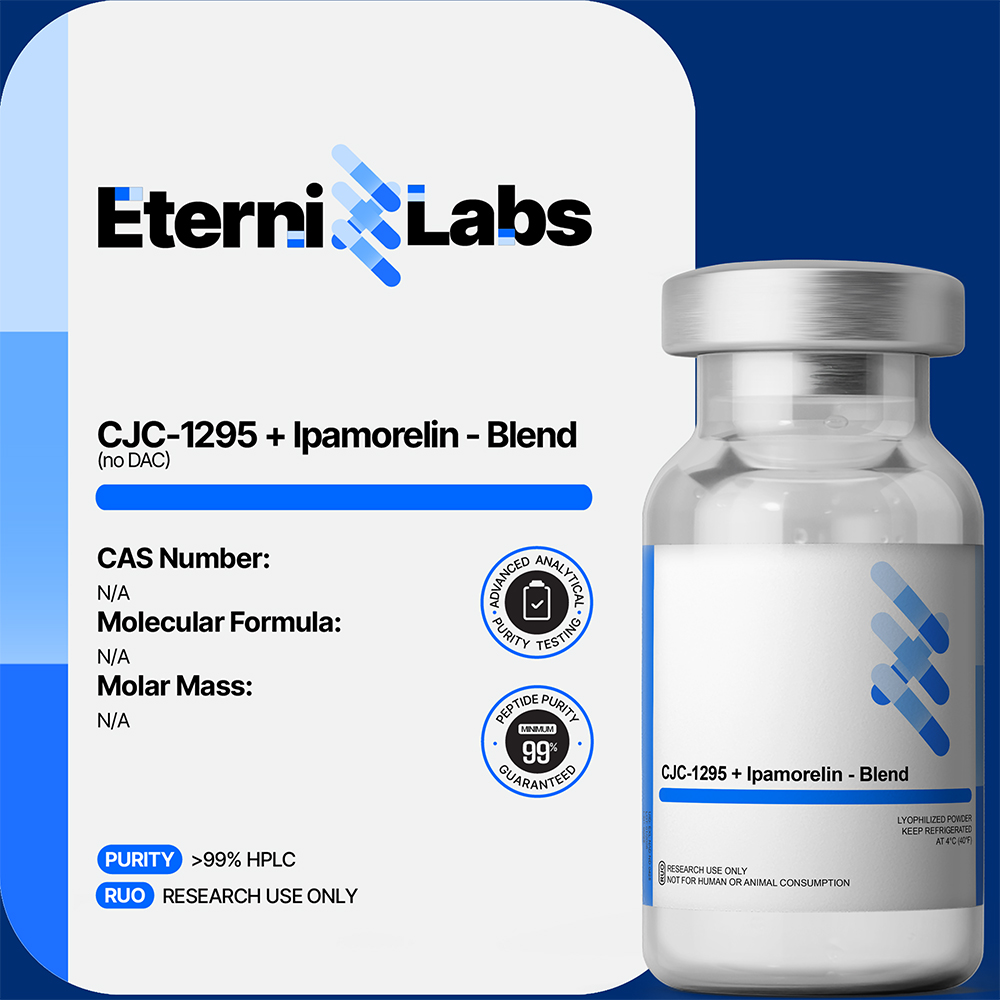
The CJC-1295 & Ipamorelin blend is an advanced peptide formulation frequently used in academic and biochemical research focusing on the growth hormone axis. This unique combination integrates two potent secretagogues—CJC-1295, a synthetic GHRH analog with DAC (Drug Affinity Complex) technology, and Ipamorelin, a selective ghrelin receptor agonist.
CJC-1295 functions by binding to GHRH receptors on the pituitary, stimulating endogenous growth hormone secretion. Its modification with DAC extends its half-life, allowing for sustained receptor activity. This property makes it particularly attractive for studies requiring consistent hormonal pulses over longer durations, such as circadian rhythm research, protein metabolism, or hormonal feedback loops.
Ipamorelin, in contrast, mimics ghrelin’s activity by targeting the ghrelin (GHS-R1a) receptor. It is known for its high specificity, which reduces the potential for off-target binding—a crucial feature for studies that demand clean, uncontaminated signal pathways. Unlike earlier generations of secretagogues, Ipamorelin exhibits minimal activity on prolactin, cortisol, or acetylcholine release, making it a more refined molecule for isolating GH-specific effects.
The combination of CJC-1295 and Ipamorelin in a single research blend creates a dual-action tool that can be used to investigate synergistic effects on pulsatile GH release, feedback inhibition, and receptor expression. Studies may benefit from the extended half-life of CJC-1295 and the potent, fast-acting receptor activation provided by Ipamorelin.
Researchers studying cellular regeneration, metabolic control, and endocrine signaling often leverage this pairing to simulate natural hormonal fluctuations. The blend offers a unique opportunity to explore the interconnectedness of hypothalamic-pituitary function, hormone secretion dynamics, and receptor-ligand interaction.
Research:
Recent studies on CJC-1295 and Ipamorelin have independently highlighted their individual roles in promoting pulsatile growth hormone release. When used in combination, researchers have observed additive or even synergistic effects on GH secretion and downstream pathways, suggesting this blend may better mimic physiological hormonal fluctuations than either compound alone.
In a controlled experimental setting, CJC-1295 has demonstrated prolonged GH-releasing activity due to its affinity-enhancing DAC modification. It allows researchers to maintain elevated GH levels without frequent administrations—ideal for longitudinal research studies. Investigations using animal models have shown that CJC-1295 can result in sustained IGF-1 release, a marker often used in tissue regeneration, metabolic balance, and cell proliferation research.
Ipamorelin, on the other hand, has been studied for its rapid action and receptor specificity. Unlike other secretagogues such as GHRP-6, Ipamorelin does not significantly affect cortisol or prolactin levels, making it more precise for GH-focused experiments. Its clean pharmacological profile allows researchers to isolate the effects of growth hormone pathways without unintended systemic responses.
In combined protocols, researchers have observed increased GH pulse amplitude and frequency, offering a more nuanced understanding of feedback inhibition and pituitary responsiveness. Some in vitro assays and rodent studies have utilized this blend to explore topics such as lean mass preservation, fat metabolism, and hypothalamic feedback loops.